Nate Thise, Muscle Activation Techniques Specialist | Why Is That Muscle So Tight?
with Nathaniel Thise, MATRx · Muscle Activation Techniques Specialist, Muscle Activation of Arizona, Scottsdale
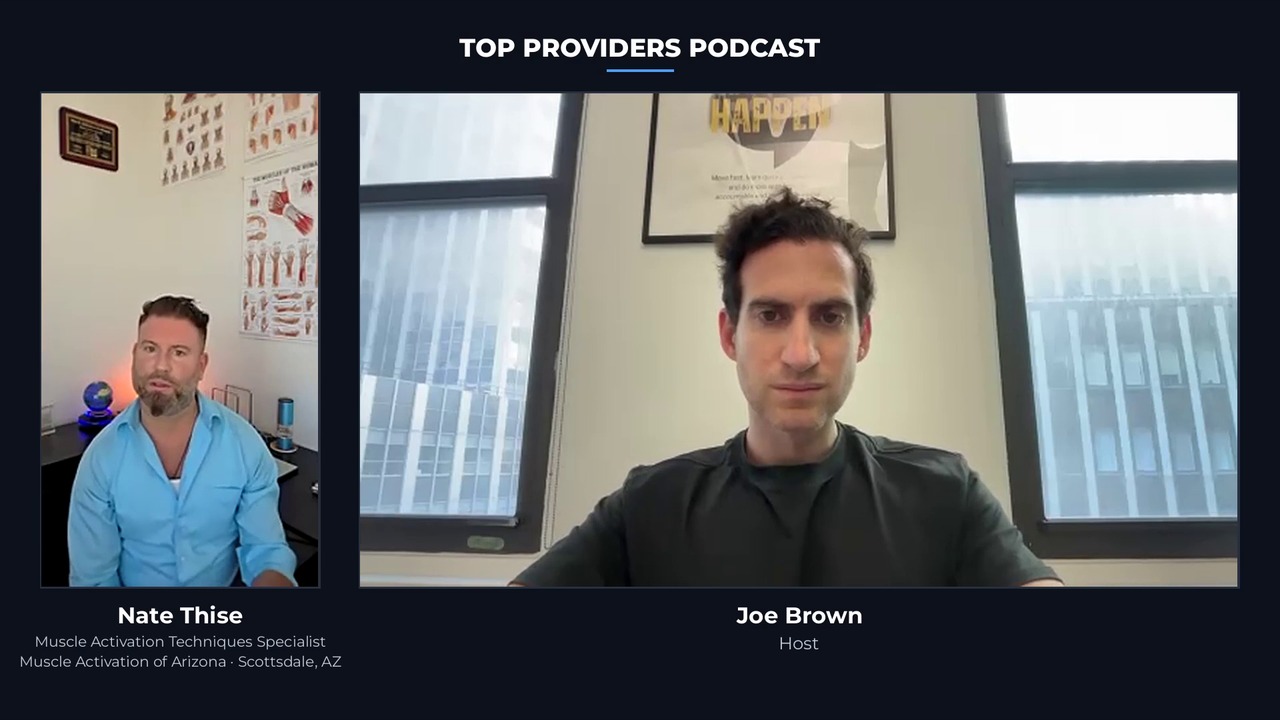
Stretch it, foam-roll it, wait for it to go away, and it keeps coming back? In this episode of the Top Providers Podcast, Joe Brown talks with Nate Thise, a Muscle Activation Techniques (MAT) specialist and the founder of Muscle Activation of Arizona in Scottsdale. Nate's view: a muscle that feels tight is often protecting something that isn't doing its job. They cover what to look for when choosing someone to work with, Muscle Activation Techniques in plain English, the real question of why a muscle is so tight, why tightness can be a protective response, Nate's own story from aircraft to muscles, what sitting all day does to your muscles and one simple thing a desk worker can do, getting back to the gym or the golf course in your 40s, 50s or 60s, why symmetry matters when you exercise, how to tell whether your sessions are working, and what to understand before a first visit. General information only, not medical advice. Muscle Activation Techniques (MAT) is not a licensed medical service. If you have pain, an injury or a health concern, check with your own licensed healthcare provider. Muscle Activation of Arizona · 14362 N Frank Lloyd Wright Blvd, Scottsdale, AZ 85260 · (480) 479-7333 · maofaz.com Meet Nate on Top Providers: https://topproviders.com/providers/nathaniel-thise
- 0:00Your body isn't a rusty antique car
- 0:14What this episode covers
- 0:34Welcome & meet Nate Thise, Muscle Activation Techniques specialist
- 1:12What to look for when choosing someone
- 2:05Muscle Activation Techniques in plain English
- 2:40The real question: why is it so tight?
- 5:17Why tight muscles can be protective
- 7:12Nate's own story
- 7:36From aircraft to muscles
- 9:12What sitting all day does to your muscles
- 11:10Getting back to the gym in your 40s, 50s or 60s
- 13:02Symmetry is the key
- 13:36How to tell if your sessions are working
- 15:31What to understand before your first visit
- 18:08Where to find Muscle Activation of Arizona
General information only, not medical advice. Muscle Activation Techniques (MAT) is not a licensed medical service.
The guest
Booking details, hours and his full background live on his profile.

Clips from this episode
Under a minute each, cut straight from the interview.
 Shorts0:42
Tight muscle? Ask why it's tight
When a neck feels tight and won't turn as far one way, the question for Nate Thise, Muscle Activation Techniques specialist at Muscle Activation of Arizona in Scottsdale, AZ, isn't just "what's tight?" but "why is it so tight?" He looks at limited motion as a sign that the muscles meant to do that job may not be firing. General information, not medical advice.
Shorts0:41Sitting all day: what it does to your muscles
Nate Thise, Muscle Activation Techniques specialist at Muscle Activation of Arizona in Scottsdale, AZ, says long stretches of sitting can leave the muscles on the front of the spine, like the abs, obliques and hip flexors, less active. His tip for desk workers: try not to get too unbalanced. Squatting is one way to shorten those front muscles and let the ones in the back open up. General information, not medical advice.
Shorts0:37Back to the gym after 40? Start here
Getting back into the gym or onto the golf course in your 40s, 50s or 60s? Nate Thise, Muscle Activation Techniques specialist at Muscle Activation of Arizona in Scottsdale, AZ, says many people take the rusty antique car out of the shed and put it straight on the racetrack. His first step: put air in the tires, check the fluids and the alignment before you start stressing it. General information, not medical advice.
Shorts0:26Symmetry is the key when you work out
Nate Thise, Muscle Activation Techniques specialist at Muscle Activation of Arizona in Scottsdale, AZ, says whatever is working on one side of your body when you exercise should feel the same on the other side. If it doesn't, something may be compensating, and that's worth paying attention to before you push harder. General information, not medical advice.
Shorts0:40From aircraft to muscles
Working with muscles wasn't in the original plans for Nate Thise, Muscle Activation Techniques specialist at Muscle Activation of Arizona in Scottsdale, AZ. In his late teens and early 20s he could feel muscles "turning off" in his own body, like his left hip during squats. That's what pulled him into Muscle Activation Techniques. General information, not medical advice.
Transcript
Transcript of the published edit. Times are episode time. Auto-transcribed; minor errors possible. A few passages are trimmed and marked […]. General information, not medical advice.
0:00most people treat their body like the rusty antique car sitting out in the shed. They haven't driven it for who knows how many decades. They dust off the, they dust it off and throw it out on the racetrack. Let's see what it can do. So Nate Thise […] now works on how muscles work. His view is that a muscle that feels tight is often protecting something that isn't doing its job. So today we're gonna talk about why stretching isn't always the answer, what muscle activation sessions actually look like.
0:32So stay with us. So welcome to the Top Providers podcast where you get to meet the provider before you book. I'm Joe Brown. Today, I'm with Nate Thise, a Muscle Activation Technique Specialist and the founder of Muscle Activation of Arizona in Scottsdale. Nate holds the advanced MATRx Level Certification in Muscle Activation Techniques.
1:03[…] Nate, thanks for joining us. Absolutely. My pleasure. Cool. Well, so […] what should someone look for when they're looking up someone who works on their aches and pains? I mean, really somebody who's got a track record and somebody who's kind of been through it. I think it's hard to get advice from somebody who hasn't experienced aches and pains dysfunction and chronic issues first hand.
1:36And I don't know if there's a particular criteria that I would say you should be looking for one must qualify with, you know, the practitioners and people that provide assistance for these sort sort of things vary from all shape and size. So I suppose the credentials and degrees make a difference. And at the end of the day, I guess you have to go with the provider that you feel is the right fit for you.
2:02And the one whose approach kind of makes the most sense. Yeah, a lot of people have never heard of muscle activation techniques. So in plain English, what is it? […] Yeah, I mean […] a lot of people would agree to a certain extent that the main issue is something's too tight. Your hamstring's tight, your erector's are too tight, your back, your glutes, your lats, your blood rate is lumbarum, your cast, your Achilles too tight. And I suppose that's more of the obvious, you know, the real relevant question is why is it so tight.
2:47And that's where this technique […] in the sense that when we are say looking at somebody's neck is super tight, they can rotate it this far to the left, they can rotate it this part of the right, despite the symptom of pain and the restriction in motion. I'm not thinking, oh, your scalenes are bound up, the spinal extensors in the neck are bound up, I'm thinking, no, the reason why your neck doesn't rotate the left as far as it does to the right is because the muscle mechanically rotate the cervical spine to the left aren't working.
3:20So we start looking at these limitations of motion more as an indication of muscles that aren't firing and are more so neurologically weak. So that's where we start to get an indication into an idea as to which muscles to potentially start testing. That's where it looks similar to a as far as applied kinesiology, looking at these muscles, ability to resist a manual muscle test, but ours are more in the in range shortened position. We're going to find more neurological and mechanical weakness. So when we start looking at the body and how it's not moving, it starts to give us an idea as to which muscles are potentially or not firing.
3:56And there's […] so many muscles that can rotate the spine to the left or right or extend it or side bend it or flex it. And again, every joint again […] has so many muscles move it into a particular range of motion. So, say we get into like elbow flexion, for, example. Say it doesn't flex on the left as far as it does the right. Again, how many muscles flex the elbow? Then we start getting pretty specific as to which ones we should start testing, right?
4:44And when we I go through and we start the biceps, the brachialis, brachioradialis, test it, treat it, and then retest it to see if what we're actually trying to accomplish is happening. And that's what's kind of wild about it. Again, when the nervous system, I mean, how specific that that's, that's pretty much a general overview, but it can get a lot more specific relative to how it works and the process behind it essentially puts, puts you back together one muscle at a time. And it's very specific relative relative to the muscles that we're And number one, and first and foremost, if R we go into that motion without muscles there to stabilize it, we might get hurt because we don't have all the muscles participating to control the motion like they should or normally would. So the nervous system senses that vulnerability and it says, hey, we can't control elbow flexion because all the flexors of the elbow aren't working, we and we're going to and start tightening up opposing muscles and antagonistic ones to keep you from going into a motion where you might get hurt.
6:11And that's kind of the way the joint normally should work. There's this agonist, antagonistic relationship between opposing muscles. I flex my elbow, the extensors relax. I extend the elbow, the extensors shorten, the opposing muscles have to lengthen to allow for that motion to take place. So we kind of look at these issues kind of in reverse order. Is it that the triceps so tight or is it one or more of the elbow flexors that oppose it are weak?
6:41But again, instead of focusing on the limitation of motion and with the muscles that move you into that limited motion We're solely focused on well the tight muscles as opposed to identifying the root cause which is again Usually always related to muscles that aren't firing neurologically So as the nervous system sense the stability as we start putting you back together one muscle at a time The nervous system says oh we can control left cervical rotation we can finally relax these things that have been tight on some people for decades.
7:11I mean, it's wild. When I was in my early 20s, my hips started acting up, I trashed a bunch of things, playing football in high school. And by the age of 25, I was a mess. I couldn't touch my toes. I could, I mean, everything was inflamed and painful and so tight. It was so tight. So that's what inevitably led me to this technique and becoming a practitioner of it. So Yeah, you worked on aircraft […].
7:40How did that lead you to working on human bodies?
8:0520s, I was in rough shape. So I started going down the traditional avenues, right? […] it just wasn't the fit for me […]. So this whole phenomenon of muscles turning off neurologically is something that I could really feel in my body.
8:30Just like my left hip it felt like when I was doing and squats, I had two different legs. And I think a lot of people can relate to that one, and having these sort of issues. So I can feel this issue of muscles not working. And again, as a result, all these other ones to compens, compensating and, and tightening up as a result.
8:55And that really resonated with me as far as well, we might need - and look at these muscles that aren't firing before we start chasing after all the symptoms seemingly associated with it.
9:30It's ones that can again really shorten in that seated position. And the longer we sit there, the more apt it is to shut those off. As a result, like we were talking about earlier, the ones on the front aren't working, the ones to start to tighten up again to the point where people can't even put their shoes and socks on. And that's a big part of the problem with most people people's shoes is being in a seated -position for an extended period of time. That's where we see the desk jockeys, the airline pilots, the semi -drivers, and people that that are in a seated -position even couch potatoes start developing and I didn't even do anything to my back so the key is to make sure that we don't become too unbalanced and as simplistic as it may sound and as difficult for some people as it may be squatting ironically is a great way to really shorten those muscles on the front of the spine and kind of get the ones on the back to open up and getting specific at all.
10:57That's, I, I guess something, something anybody can do. And it's, it's kind of ironic that cultures that still go to don't do it for a couple of decades where it becomes problematic. So to to make a long story short that's I guess something people can do. That's great and for someone who's in their 40s or 50s or even 60s who want to get back into the gym or onto the golf course, what do they get wrong? Well most people treat their body like the rusty antique car sitting out in the shed.
11:24They haven't driven it for who knows how many decades. They dust off the, they dust it off and throw it out on the racetrack. Let's see what it can do. And that just intuitively doesn't really make sense, right? So the first step we really want to be taking is to make sure that the muscles that should be working in a particular exercise actually are. And I mean, just talking about how many muscles are involved in a squat, pretty much all of them other than our arms, everything's used, everything's getting used in that motion.
11:54So the first step would be, again, if we're relating to the analogy of a car, maybe put some air in the tires, check the fluids, make sure the thing can actually run, the alignment's not totally shot before we start stressing it, and putting external forces on muscles that are not even going to be working. And that's the thing that's a big misconception in exercise […] is just because the muscle should be working in a particular motion doesn't mean it is.
12:20And the second we start developing these pains and injuries and the accompanying tightness that comes with it, we start to quickly realize, yeah, something in there is just not working like it should. So again, if we've got four major flexors of the elbow, again, going back to that example, and two or three of them are working, the last thing we want to do is to go into the gym, throw those vulnerable ranges of motion under external load. And there's no coincidence that's where we get hurt of our body and again that's unfortunate how so many people fall into that as they are trying to get back into the gym.
13:02So I mean the biggest thing I guess without getting too complicated is whatever's working on one side of the body when we're exercising should be working and feeling the same on the other. Symmetry is the key. If it's not then one side or the other both is compensating. Symmetry is the goal with our exercise so if it's not feeling symmetrical when we work out, we're likely going to contribute to the imbalance and make it worse. And then welcome to 90 % of the workout enthusiasts as they get older, they just can't push it without something getting irritated or an old injury popping up or a new one, again, presenting itself.
13:35That's great. That's great. And how does, how should someone tell whether their muscle activation sessions are working for them? Well, it's pretty straightforward as far as what starts to happen as muscles can't The first sign is, again, a protective guarding and tightening of the muscles as the nervous system senses weakness in that range of motion. So we can expect to see when somebody comes in, is, well, we can't move into this motion. It's like, well, we just tested all those muscles in that trunk rotation, right, whatever flexion, and they're not working.
14:08So we start to fire them up. And that's what's kind of, again, cool. As the body starts to guard against these unstable ranges of motion, it will tighten up in a protective response. As we start putting you back together, and essentially one muscle at a time, the nervous system says, oh, we can control trunk rotation, or flexion, or extension, or side bend, whatever motion. And it starts to relax. Again, these muscles have been chronically tight for years. So we should see a substantial, if not a noticeable improvement from every time we jump off the table.
14:34And again, that's how we go about putting people back together, essentially one muscle at a time. If it's moving in the right direction, I'd say […] we should be noticing […] changes, both with our symptoms of pain and tightness but with the body's ability to handle external stresses off the table. Say when we're starting, say we're trying to get into running and at five miles we start feeling some hip or knee thing, then as it gets worse it's four miles, then three miles, then two, and one, then we start to feel it all day every day.
15:11But the goal with this technique is to raise the threshold of the muscles ability to handle those loads without falling, without, you know, without them regressing into the point where we've got to really overdo it to shut things off and cause the body to guard and tighten and start screaming out in pain. That's great. That's great. And the last question I have for you, you know, you've been the person with the tight hips at 25 who tried everything. So what do you want someone in that spot to understand before they walk through your door for the first time?
15:42Well, the thing that's interesting about every injury in the body is how it's always related and generally always related and connected to something that it's attached to. So we start seeing the hip or the femur is directly attached to the pelvis. Well, if the pelvis is unstable, then how does the hip ever have a foundation to anchor itself into? So I wish there was a simple and straightforward answer to that, but it does start to become really specific.
16:07It could be some pelvic instability on the other side of the body causing this hip pike issue with a appeared shorter leg on one side or the other, and we can't just jump into that area and expect anything to happen. And the knee is a great example of that too. I mean, again, it's just a hinge joint. There's very little tibial rotation out of that. So the tibia and the femur comprise the knee joint. But again, if the hip is unstable, then that's going to translate into dysfunction in the lower leg and foot and knee as well. and if the pelvis again that the hips attach to isn't working then again that could be part of the issue.
16:48So it really becomes specific. I mean how many muscles and how many motions does the hip have? Kind of flexes, extends, it adducts, rotates internally and externally and there's a lot of different muscles that are responsible for those motions so I guess the question will be what tight end or what's the tightness relative to which ranges of motion aren't working it starts to give us an idea as to which muscles are likely the culprit, but I can tell you that the big hip flexors tend to be a huge part of most people's problems relative to hip discomfort because when the hip flexors, psoas, iliacus in particular, stop firing, then again the quad and groin will start to jump in.
17:29The deep external rotators like the piriformis and or even the superficial glutes will start to tighten as again there's nothing to oppose it. And because of that, so as is attachment to our lumbar spine, pelvis and hip, we can start to see that influencing SI joints on the back of the spine creeping up again throughout the entire body and down to the lower leg and foot. So it's really kind of wild to see how much one muscle can influence a particular joint and or number of joints, let alone a multitude of these muscles and imbalances not doing their job.
18:03So that's kind of the long answer I suppose. That's awesome. That's awesome. Well, for anyone in Scottsdale and the Phoenix area, that's Nate Thise, a muscle activation technique specialist and the founder of muscle activation of Arizona. He's located at 14362 North Frank Lloyd Wright Boulevard in Scottsdale. You can call 480 -479 -7333 or visit MAOFAZ .com and you can find Nate's profile on topproviders .com. Nate, thanks for helping us understand why tight muscles are often a sign of something else. And if you found this helpful, subscribe to the Top Providers podcast where you can meet your next provider before you book.
18:52I'm Joe Brown and thanks for watching. Thanks Joe, I appreciate you having me on.