Therapist, Psychiatrist or Psych NP? When to Get Mental Health Help | Blaine Guelde-Patel, APRN
with Blaine Guelde-Patel, APRN · Psychiatric Nurse Practitioner, Integrative Health & Healing, Orlando
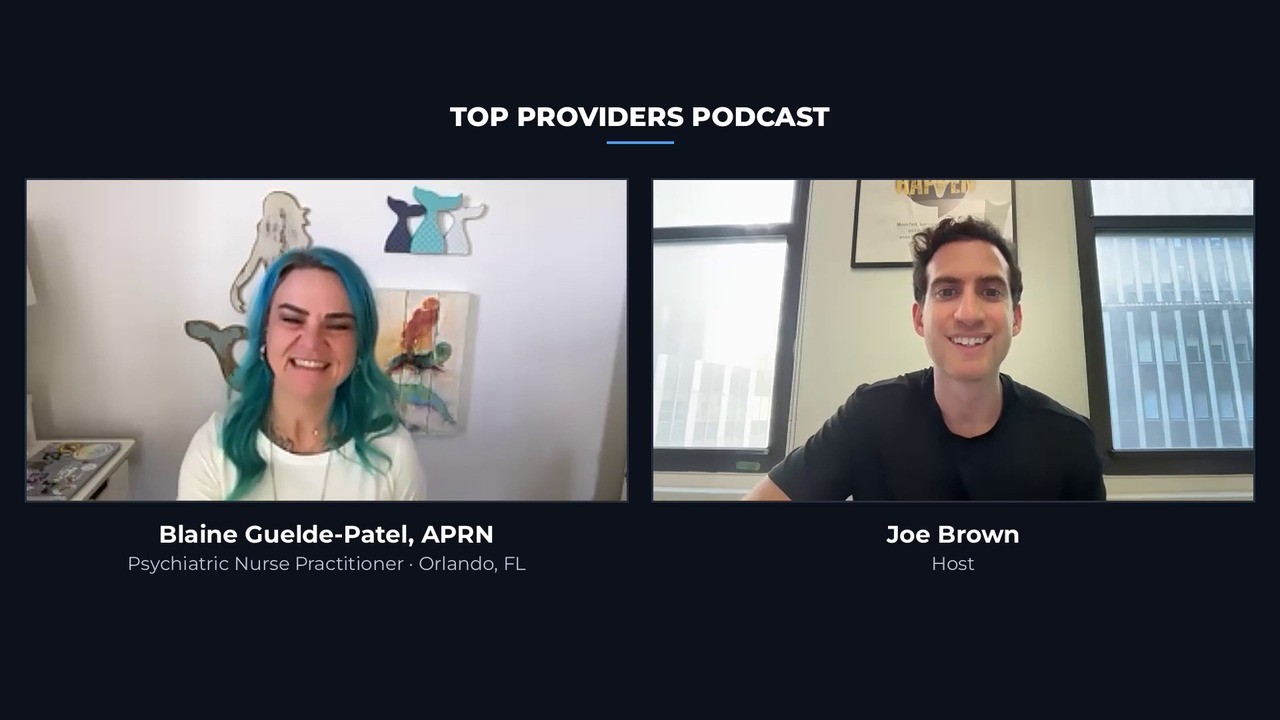
Not sure whether you need a therapist, a psychiatrist or a psychiatric nurse practitioner? In this episode of the Top Providers Podcast, Joe Brown talks with Blaine Guelde-Patel, APRN, a psychiatric-mental health nurse practitioner who founded Integrative Health & Healing in Orlando, FL. Blaine covers: - What to look for in a mental health provider - How a therapist, a psychiatrist and a psychiatric nurse practitioner differ - What happens at a first appointment - How an adult ADHD evaluation works - The signs it's time to get help, and why you don't have to wait for a crisis - How medication decisions get made, at a pace you're comfortable with - What working at a trauma center taught her about pain and mental health - What to do when a loved one won't get help This episode is for general information and isn't a substitute for advice from your own provider. If you're thinking about suicide or self-harm, call or text 988 to reach the 988 Suicide & Crisis Lifeline, or call 911 in an emergency.
- 0:00They're the expert in themselves
- 0:04What this episode covers
- 0:41Welcome & meet Blaine Guelde-Patel, APRN
- 1:16What to look for in a mental health provider
- 2:03Therapist vs. psychiatrist vs. psych NP
- 3:33What happens at your first appointment
- 5:20Adult ADHD: how an evaluation works
- 6:23When it's time to get help
- 8:15Afraid of medication?
- 9:42What a trauma center taught her about mental health
- 11:51When a loved one won't get help
- 13:14What she wants every patient to know
- 14:11Where to find Integrative Health & Healing
For general information, not a substitute for advice from your own doctor.
The guest
Booking details, hours and her full background live on her profile.

Clips from this episode
Under a minute each, cut straight from the interview.
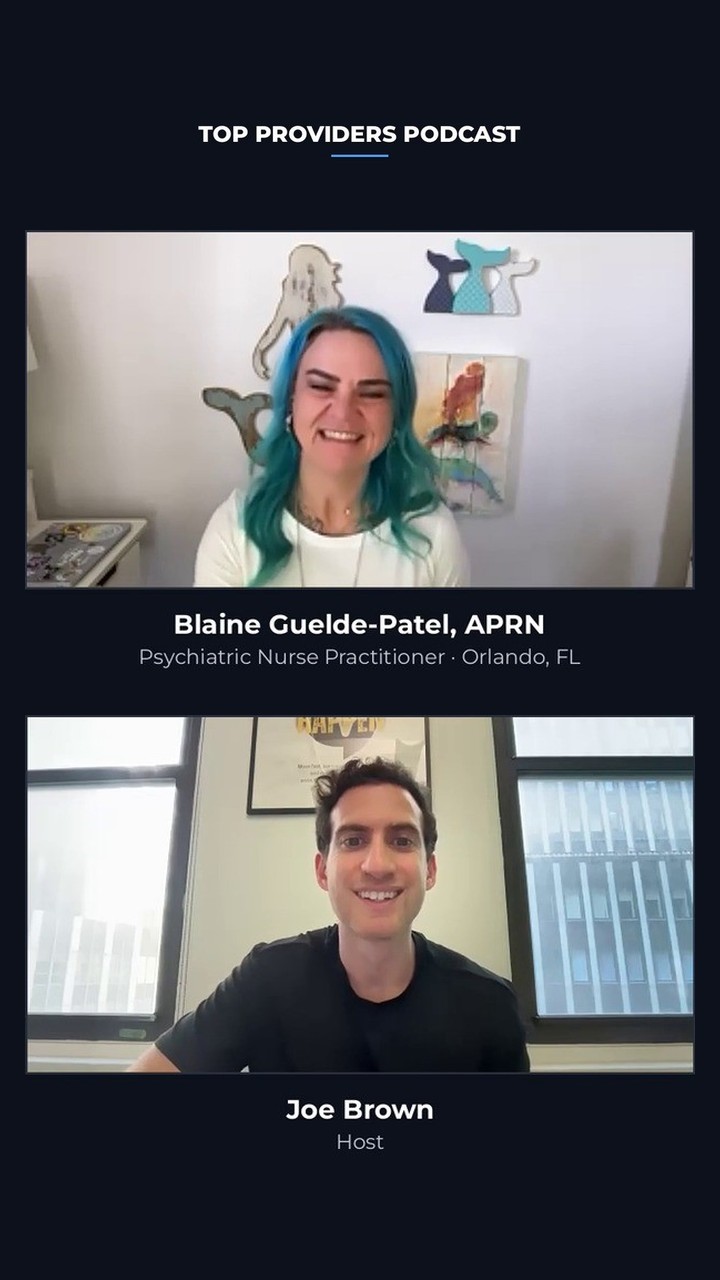 Shorts0:31
Therapist, psychiatrist or psych NP? The difference
Not sure who to see? Blaine Guelde-Patel, APRN, a psychiatric-mental health nurse practitioner, explains the difference: a therapist focuses on talk therapy, while a psychiatrist and a psychiatric nurse practitioner both mostly prescribe medication. General information, not medical advice.
Shorts0:39The sign it's time to stop waiting and get help
You don't have to wait for a crisis to get support. Blaine Guelde-Patel, APRN, describes signs it may be time to reach out, like trouble getting out of bed, getting work done or enjoying the things you used to love. In a crisis, call or text 988. General information, not medical advice.
Shorts0:35Scared of mental health medication? Watch this
Afraid of medication? Blaine Guelde-Patel, APRN, explains that medication isn't always the first step, and that when she does start it, it's at a low dose, only with your permission, and with a plan you're comfortable with. General information, not medical advice.
Shorts0:35What a trauma center taught her about mental health
Pain affects more than the body. Blaine Guelde-Patel, APRN, shares what working in pain management at a trauma center taught her: pain can disrupt sleep, lower mood and pull people away from friends, family and work. General information, not medical advice.
Shorts0:24Picking a mental health provider? Start here
Looking for a mental health provider? Blaine Guelde-Patel, APRN, suggests asking friends and family who they've seen, and looking for someone you can connect with, feel safe with and be honest with. General information, not medical advice.
Transcript
Host: Joe Brown. Transcript of the published edit. Times are episode time. Auto-transcribed; minor errors possible. General information only, not medical advice. In a crisis, call or text 988.
0:00I may be the expert in the medicine, but they're the expert in themselves and what's going to make sense for them. So if you've ever sat down to do one simple thing and lost an hour or laying awake replaying a conversation from three days ago, you've probably wondered is it just me or is it something else?
0:16So Blaine has spent more than 20 years in healthcare from [a trauma center in Baltimore] to her own mental health practice in Orlando, helping people answer that one question. Today, we're going to talk about what to look for in a mental health provider, how adult ADHD actually gets evaluated, and how to know when it's time to stop waiting. So stay with us.
0:41So welcome to the Top Providers podcast, where you get to meet the provider before you book. I'm Joe Brown. Today I'm with Blaine, a psychiatric nurse practitioner and the founder of Integrative Health & Healing in Orlando, Florida.
0:55Blaine trained at the Virginia Commonwealth University and the University of Cincinnati. She started her career at the University of Maryland's Shock Trauma Center and spent four years at the University of Maryland Center for Integrative Medicine and now helps adults across Florida with ADHD, anxiety and depression.
1:12Blaine, thanks for joining us. Thanks for having me. I'm excited.
1:16Great. So for my first question after you is, is for someone who's looking for a provider or mental health, what should they be looking for outside of like a Google listing? Thanks for that you feel comfortable with there's a lot to be said websites can be very helpful and you know finding a website that feels good for you it's it's what makes sense for you and I would say that also asking friends and family and see you know who they see or have seen in the past or if anyone knows of someone but it's looking for someone that you feel like you can connect with, that you feel safe with, and that you can be honest with because honesty is really important with what we do. That's great. there's a lot of people who don't know who to call. They should call a therapist, psychiatrist, call or a nurse practitioner like you.
2:10In plain English, what is the difference between those? That is a really good question. A lot of people have it and it took me even a long time to figure out exactly what it all meant. So a psychologist or a therapist is going to be more of the talk therapy. They're going to talk to you for that hour long visit. They're going to help you to explore explore your feelings and your feelings and things that where the psychiatrist is a physician, and then a psychiatric mental health nurse practitioner is a nurse practitioner that specializes in mental health and psychiatry and so both of us prescribe medications mostly and so we spend you know our time talking to you about like what you're how you're feeling what's going on, symptoms that you're experiencing and then we work with you to figure out what kind of medication regimen will work best you know and it's there is a different technique sometimes on how to handle it so So finding someone that fits the technique that makes, or finding a technique that fits you and feels good for you is important, but there's a lot of good providers out there that can be helpful on both ends, whether it's the psychiatrist or the mental health nurse practitioner.
3:34And for someone who's nervous about their first appointment, walk them through it. What actually happens so that is something that I always tell people when they come in I'm like the hardest part is over you've made the appointment and now you've come in and now it's gonna be a conversation this is how I do it I have conversations with these people and I get to know them and I remind them that they're gonna talk to me about the thing they know the most about which is themselves and they're experts in. so we spend the next like about an hour. I go through questions I asked them about the symptoms. They're experiencing their history that of medications They've taken you know the medical history the mental health history their family history Get to know them and see what's going on with them and then also find out what's important to them What is it that they're looking for some people come in and they're like I want as little medicine as possible And And so we work with, I work with that and I work with the patient because it's a collaborative approach. You know, for me, I make sure that, um, you know, the patient feels heard and I tell them, you know, if there's ever anything that you don't like or that you're hesitant about, let me know, because there's a lot of ways to do this.
4:46And if something doesn't feel right for you, I need to know because you're obviously not going to do that that that way or try a medicine if you're not comfortable with it and so you know it's just really getting starting to get comfortable with each other and starting to come up with you know diagnosis can occur during that first visit and also treatment can occur in that first visit for me I intend to do that because because that's what people are looking for a lot of of times and so I want to make sure that they're getting their needs met as best we can, but in a safe manner, And a lot of adults are wondering, you know, do I have ADHD or am I distracted like everyone else. So how actually right now I see more adults than I've ever seen looking for this ADHD diagnosis or seeing if they have it and so I do I have a form that they and the intake paperwork that they complete called an ASRS it's um it's just a self-audit tool that they have and it tells me it can give me and then does have ADHD and then I also use a test and that's online at home.
5:58It's only 20 minutes but like I tell people it's sometimes the longest 20 minutes of your life. They get very frustrated with it. Some people fall asleep with it. there's been a huge influx of a gnosis over the last six plus years after coming because we all started working from home and it was like wait a minute like how am I supposed to work and how can I stay focused with all these other things and then we go from there with treatment wise That's great, that's great. And how how does someone know it's time to get help and not just to ride it out? Well, that's a personal preference. I would say, you know, within the healthcare and your mental health industry, practice or medicine, we, you know, diagnosis comes when something's been around for about six months or more. I would say that if there's ever any sort of like suicidal ideations, self-harm ideations, immediately get help. 988 is a good place to go to.
6:53211, and obviously 911. Reach out to friends and family. Let someone know that you're struggling. But it doesn't have to get to that. Like, you don't have to wait until you have suicidal thoughts or self-harm thoughts or these really bad, negative, intrusive thoughts to get support. If you know you find that you're having trouble getting out of bed you're having trouble brushing your teeth, getting you engaging with your children, getting your work done, you're not having the joy that you used to have with your activities. Those are all like signs that something's going on. A change in your appetite, a change in your energy, a change in your focus, all of that, even just slightest changes can indicate that something's going on and so you know I really want to encourage people not to wait till it's so bad that it's intolerable but instead just kind of pay attention and then reach out and it may not warrant medication management initially you to figure out if there is something going on going on that's mental or is it burnout or is it you know something else or we you know we look at medical reasons too.
7:58You know, we look at labs and stuff. you know it's just paying attention and then you know again not waiting until things are so dire that it's hard we can still help and we can still work through it and and get you know getting you get you feeling better but it doesn't have to be that bad before you seek help A lot of people are afraid of medication, side effects, feeling like a different person, being on it forever. So how do you decide with the patient whether medication makes sense.
8:26Right, so it's oftentimes it's the severity of the symptoms if it's impact, you know, work, home, relationships, self-care, and how impactful is it? Again, if it's lasted for six months or more, some things can come and go.
8:44It's, you know, how problematic is it for you in your daily life? Like how bad is it?
8:50And then, you know, we don't always have to do medications right away. Sometimes it's, you know, we can refer you out to a therapist. I send basically everybody to therapy or suggest that they go to therapy.
9:01So, there are other ways to manage the symptoms without medicine. Now if we do you you know, if I do start someone on the medication it's always at a low dose.
9:13And it's always with obviously their permission. You know, I want people to feel comfortable. I want each patient feel comfortable with the plan that we come up with. And you know, I talked to them about that. Like, here's my thoughts. Like I, I may be the expert in the medicine, but they're the expert in themselves and what's going to make sense for them. And so I really encourage, you know, Them to advocate for themselves. If they're comfortable or uncomfortable with something to please let me know. So then we can go from, we can adjust the plan from there. That's great, that's great and you started your career at the shock trauma center in Baltimore helping patients through pain So what did that teach you about mental health? Oh wow, yes, so I started as a when I became a nurse practitioner with my first degree as an acute care NP I did start in pain management and seeing the people suffer was really hard like it's a it's a the highest level trauma center that you can experience lots of you know violent injuries come in lots of car accidents from all over the area and the Northeast and Mid-Atlantic region and And so, you know, seeing them have a hard time, they end up with depression, seeing how the pain and the discomfort really impact the mental health.
10:30And even like today, I have patients that experience discomfort or pain.
10:37I don't like to, because we give pain such power, I try to take it away and say, you know, talk to them about their discomfort. I don't minimize it, and I don't treat it these days, but I do talk to them about that because it does impact the mental health. You know because it can impact their sleep patterns, which then decreases their mood, which makes them less likely to want to engage with friends, family, work, things like that, the things that they enjoy and so it's you know talking to them and because people are more than just a diagnosis they're a whole person and so I really try to get that 360 view of people when I work with them so that you know they feel heard and then you know we address the things as appropriate and it's not always me that's addressing it it's I send them you know suggest that they talk to their pain management doctor or to get a pain management doctor if they don't have somebody or talk to their primary care doctors. So it's, it's an integrative collaborative approach. I've talked to, you know, I tend to talk to therapists more than anyone but like I have no problem talking to someone's primary care doctor if they want to talk about how things are going and what's going on.
11:44So it's you know again just meeting the people where they're at and really trying to help them and support them through what they're going through, this journey. That's great, that's great. For a spouse or parent or a friend who's watching someone struggle with or struggle who won't get help, what do they actually do? Well, as a parent, you can make an appointment for your child. That doesn't always work out so well because they do have their own free will and sometimes they engage and sometimes they don't. And then as a loved one, you can say, listen, or, you know, another type of loved one or friend and family member, spouse, you know, look, like I'm concerned, like your thing, something's different.
12:27And you're not yourself these days. And why don't you why don't we just talk to somebody, maybe offer to go with them, maybe offer to set up an appointment, or to ask around because the hard part all this oftentimes is finding someone that you can get an appointment with. So sometimes it does take a minute to find that provider and then so maybe offering to help you know just do some research for them and give them a list of people to maybe make a phone call or offer to make those phone calls and then you know try to find it that way and then maybe even come into the appointment.
13:03It's the way that I do it is I tell the patient if you want you know your parent loved one significant other to come in I'm okay with it if you're okay with it and so it's again just meeting them where they're at. That's great and the last one I have for you is after more than 20 years in healthcare, what do you want a patient to understand before they walk through your door or before they do a video call with you?
13:26That there is no judgment.
13:30That this is a judgment-free zone, literally a judgment-free zone.
13:34My only goal is to help people live their best lives in whatever manner that is. Again, something that I'll I'll tell people like, if there's ever a time where we're not connecting or we're not jiving and you're just not feeling like we're working well together, let me know. I have friends in the area that, you know, are also nurse practitioners and I can refer you out. But it's mostly that people, you know, find the right person that they feel comfortable with. And I hope to be that for these for people and thus far it seems to go pretty well Awesome awesome well for anyone in Orlando or across Central Florida and by video across the state. That's Blaine, psychiatric nurse practitioner and the founder of Integrative Health & Healing her office is at 1516 Hillcrest Street Suite 309 in Orlando You can call 689-233-9653 or visit integrativehhfl.com.
14:41And you can find Blaine's profile on topproviders.com. And if you or someone you love is in crisis, call or text 988 to reach the Suicide & Crisis Lifeline at any time. Blaine, thank you for helping people feel a little less alone in this.
14:58And if you found this helpful, subscribe to our YouTube channel, where you get to meet your next doctor before you book. I'm Joe Brown, thanks for watching.