How to Choose a Primary Care Doctor | Dr. Chetan Vaid, Internist
with Dr. Chetan Vaid, MD · Internal Medicine, Greenwich Private Medicine, Cos Cob
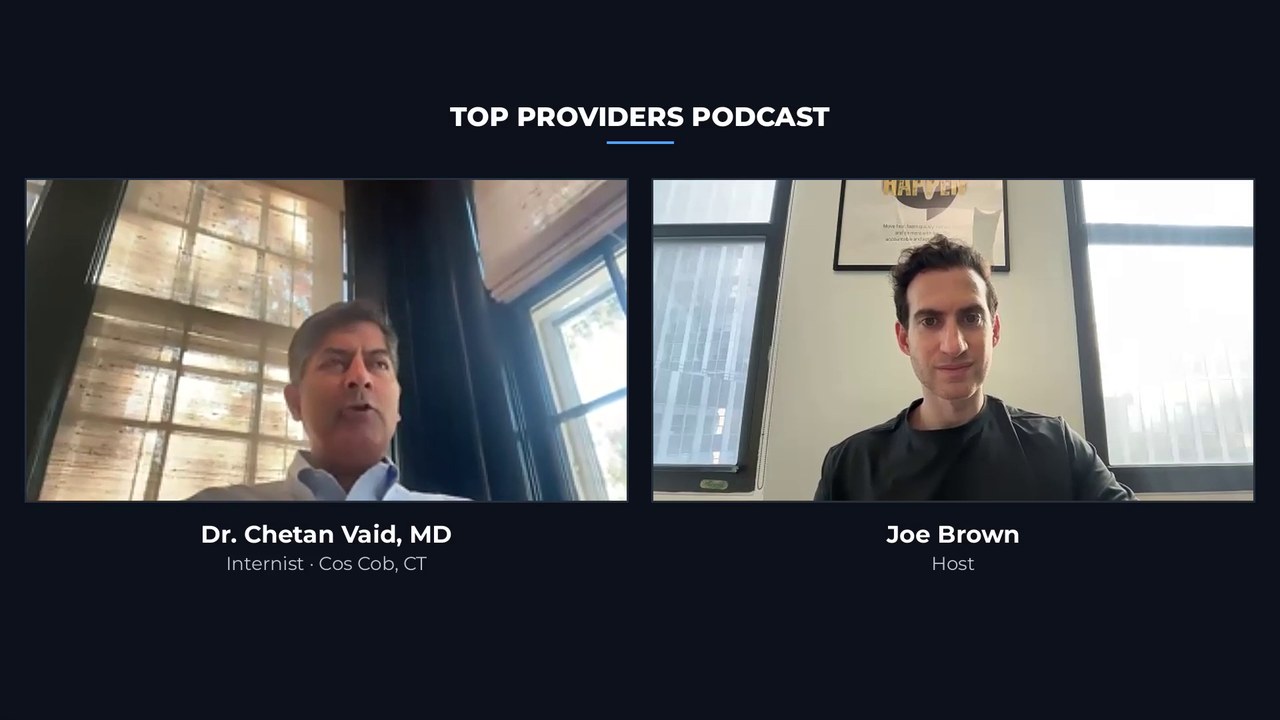
Fifteen minutes is about how long a lot of people get with their primary care doctor, and it's rarely enough to talk through what's actually going on. In this episode of the Top Providers Podcast, Joe Brown talks with Dr. Chetan Vaid, MD, a board-certified internist at Greenwich Private Medicine in Cos Cob, Connecticut. Dr. Vaid covers: - What to look for in a primary care doctor - Internist vs. family doctor, in plain English - What changes when your doctor has time - Which checkup numbers to know, and why one reading never makes a diagnosis - High blood pressure you can't feel - Making sense of advice from several specialists - Ticks and Lyme disease in Fairfield County: tick checks, removal and rashes to watch for - Helping an aging parent work with their doctors This episode is for general information and isn't a substitute for advice from your own doctor. Everyone's health is different, so talk to your doctor about what's right for you.
- 0:00One number never makes a diagnosis
- 0:05Fifteen minutes is rarely enough
- 0:38Welcome & meet Dr. Chetan Vaid
- 1:10What to look for in a primary care doctor
- 2:36Internist vs. family doctor
- 3:49What changes when your doctor has time
- 4:56Making sense of checkup numbers
- 5:49High blood pressure you can't feel
- 6:59Seeing too many specialists
- 8:33Ticks & Lyme in Fairfield County
- 11:34Caring for aging parents
- 12:59Before you walk through the door
- 13:27Where to find Dr. Vaid
For general information, not a substitute for advice from your own doctor.
The guest
Booking details, hours and his full background live on his profile.

Clips from this episode
Under a minute each, cut straight from the interview.
 Shorts0:34
What to look for in a primary care doctor
What should you look for in a primary care doctor beyond the star rating? Dr. Vaid, an internist, looks for someone you can connect and talk with, a doctor who listens and doesn't rush the visit. General information, not medical advice.
Shorts0:43What gets missed in a short visit
Many patients come in with more than one concern. Dr. Vaid, an internist, describes the 'door handle question' that comes up as a visit is ending, and why having time to get through the whole list matters. General information, not medical advice.
Shorts0:36Why you can't feel high blood pressure
High blood pressure often has no symptoms you can feel. Dr. Vaid, an internist, explains why one reading never makes a diagnosis and why readings are looked at over time. Ask your own doctor about your numbers. General information, not medical advice.
Shorts0:36Seeing several specialists? Who puts it together
Seeing four or five specialists and taking a long list of medications? Dr. Vaid, an internist, describes helping patients understand each specialist's goals and how the whole plan fits together. General information, not medical advice.
Shorts0:38Fairfield County ticks: where to check your body
After time outdoors, do a tick check. Dr. Vaid, an internist, points to where clothing gets tight: socks, waistline, hairline and neck, and under the arms. If you find a tick or a rash, contact your doctor. General information, not medical advice.
Transcript
Host: Joe Brown. Times are episode time. Auto-transcribed; minor errors possible. […] marks a passage removed from this transcript; words in [brackets] are an edit. General information only, not medical advice.
0:00One number never makes a diagnosis. One number never kind of locks you into a problem. Fifteen minutes. That's about how long a lot of people get with their primary care doctor, and it's rarely enough to talk to them on what's actually going on. Dr. Vaid has spent more than 25 years as an internist in Greenwich, Connecticut, and has built his practice around the opposite, unhurried visits and a doctor who picks up the phone. Today we're going to talk about what to look for in a primary care doctor, the numbers on your checkups that matter the most, and when to call a doctor versus going straight to the ER. So stay with us.
0:38So welcome to the Top Providers podcast where you get to meet the doctor before you book. I'm Joe Brown. Today I'm with Dr. Vaid, [an internist at] Greenwich Private Medicine in Cos Cob, Connecticut.
0:52Dr. Vaid earned his medical degree at Rutgers New Jersey Medical School, trained in internal medicine at Thomas Jefferson University Hospital, where he was named the most outstanding resident and has been caring for patients in Greenwich for more than 25 years. Dr. Vaid, thanks for joining us. Thank you very much. So for those watching, what should someone look for in a primary care doctor outside of a Google rating?
1:17Well, obviously someone who you can kind of bond with and communicate with. Almost immediately I would feel that the doctor walks in the room and you understand that, okay, here's someone I can get in touch with and relate to. And that almost to me, it happens instantaneously.
1:34[…]
2:23I want to make sure when a patient comes in, they kind of feel like I listened to them and that I'm not rushing them and that they have time to kind of talk and express themselves. And that's the best way you can provide medicine, I think. And a lot of people don't know the difference between an internist and a family doctor. So in plain English, what does an internist do?
2:45So overall, they're very similar. Internists probably are a little bit more hospital based and kind of kind of maybe, I don't want to say understand, have like more of a relationship to the hospital in terms of transferring patients back and forth. And I also think it's a geographic thing. I think in the Northeast, it's more internists, maybe Midwest to the south, it's more family practitioners and I think it has to do with access to care. Family practitioners probably take care of like a wider variety of problems that relate to kind of internal primary care. Maybe pregnancy with women, neonates, people like that, Um, infants, internists I think mainly take care of more adults, 16 years to like 99 years. I don't take, me personally, I don't take patients who are under 16, so I kind of pick them up once they kind of graduate the pediatrician and then I take over from there, but anyone below 16 I usually don't take care of. And you built your practice around unhurried visits and direct access to you. So from the patient's side, what changes when the doctor actually has time? Well, I think you're able to get through that problem list. Most patients come in with not just one issue, several issues. We were always taught when you're younger that patients will have that door handle question where you're done with the visit and you feel like you've touched on the on the points the patient wants to kind of address and then as the patient gets up to leave they touch the door handle to walk out or as you're touching the door handle to walk out the door the patient has one more question and now you have to go back and sit down and talk to the patient about that question meanwhile the clock is ticking for a doctor.
4:34Not that you don't want to address it but there are other patients that are waiting to be seen. I always joked that I was that doctor who would be talking to the patient, we'd be addressing their problems, and there'd be a knock on the door as the nurse was kind of knocking to kind of get me to move along to the next patient. And that was always very frustrating for me, and I always felt guilty about that with the other patients. That's great. And when someone gets their annual physical, which numbers should they actually pay attention to? Well, I think all the numbers are important. And that's part of the unhurried visit aspect that I think is so important. Because when you come in there, I think patients should always know their numbers. They need to know what their blood pressure is. They need to know their sugars, their cholesterols. And it's important because if you don't know these numbers and you don't understand what these numbers are or what they mean, then you can't help yourself because inevitably you're going to see a different physician, another doctor at some point in time and you want them to, you want to be able to relate to that doctor that you have this blood pressure, that you have this cholesterol, and that's the only way I think you can take care of yourself. But that only comes about through education, through conversation, through giving that patient a chance to ask questions, thus an unhurried visit. And, you know, you call high blood pressure something that people can't feel. Why do you do that? Because oftentimes you can't. I mean, classically patients will say, oh, I feel kind of flushed. I have a headache. But oftentimes it can run high and you just don't realize that it's running high. It's in your system and so patients a lot of times patients will come in and they'll say oh that's white coat hypertension. I get anxious when I see the doctor but white coat hypertension is still hypertension and you need to kind of be careful about that. One number never makes a diagnosis. One number never kind of locks you into a problem. You always have to look at the those numbers over time and you have to look at the trend of the numbers. So though you may have high blood pressure now you need to kind of maybe go home and monitor your blood pressure because it was high in the office and you look at several readings over time and you could just be sitting there watching television and you don't realize that your pressure is high. Not that I'm telling everyone to kind of check their blood blood pressure 20 times a day but which is probably just going to make it worse but but at least a couple of times here and there, there's an issue with the blood pressure, it should be monitored. And lots of patients, especially older ones, are seeing four to five specialists and taking a long list of medications. So how do you help someone make sense of all of them? Well, I think an internist or a primary care provider, that's one of our primary jobs, I think is to, I call that advocacy. You need to advocate and guide and direct the patient. Patients, a lot of patients will come and see me because they're just lost and they don't know kind of where to go next and they have a lot of questions. This doctor wants me to do this. This doctor wants me to do that. I'm taking all these medicines. What should I do? What's the next step? Who should I listen to? And so your goal is to kind of put that all together for the patient again make them understand What's being trying to be accomplished in terms of your treatments? What's the primary problem? What's each pro? What's each specialist purpose?
7:51And then kind of say okay. This is the way you should go. This is I don't want to say correct This is a this sounds like a sound plan here now Let's follow through on this level and then your job is to put it all together for the patient and make sure that they're achieving each objective that each specialist wants to achieve. And I think that's kind of a major job for an internist. Again, that takes time, that'll take follow-up, you know, kind of maybe getting notes and at times even contacting the specialists to feel out kind of what their standing is on a topic and what their goals are. This is not something, you know, a five-minute, ten-minute visit can accomplish. It takes more time, I think. That's great. And Fairfield County has a lot of ticks. So, when should someone who found a tick bite or has a rash or fever after being outside call their doctor? Well, if you find a tick, the first thing is Whenever you go outdoors, always do that tick check, we call it. So come inside, look at your body, look at your legs. And ticks, typically, like we always say, will bite, will kind of get on you and then work their way upwards. So always look at kind of where clothing's kind of, where the clothing kind of becomes tight around your body. Socks, waistline, and around your hairline and neck. Under the arms, I think also is a common place where we'll see them. If you see a tick that's attached to you, the key thing is remove it right away. The quicker and sooner you remove it, the better. Take some tweezer, kind of grab it by the head and see if you can firmly kind of pull it off. Try to get it off you immediately.
9:30And a lot of towns will have at their town halls, will actually provide a service where you can take the tick in a plastic bag and have the tick checked for Lyme disease.
9:41So that's often sometimes I'll have people do. I've done that myself with myself and my children to get the ticks checked for Lyme.
9:50So that's the first thing.
9:53Sometimes you don't see, a lot of people don't see the tick and they don't feel the bite so what you do is you look for um you'll have like the development of what they call the bullseye rash so there'll be this red circular rash so the classic bullseye rash we think of like a target kind of circular bullseye but they don't always look like that and this is one of the major things I'll say if you get kind of a red slightly raised rash about this like almost like a welt the size of, a say quarter that typically is a localized reaction to a bite but if you get more of a diffused reddish kind of about oval shaped and I will say the palm of your hand a rash about the size of your hand and that could be synonymous with Lyme disease and those should you should obviously contact with your contact your physician right away if you see that and I think anytime you get a tick, it's probably wise to contact your physician just to discuss the options there. Sometimes you can get a preventative treatment with antibiotics or immediately if you get some antibiotics within the first 24 hours, you can reduce the chances of developing Lyme disease down the road.
11:05I usually take that on a case-by-case patient with my patients but I usually go through this process of explaining to patients kind of what to look for with a tick and this is what I find in the office are the various rashes and the rash does not have to appear where you were bitten it can appear almost anywhere so it's careful that if you had a tick bite and you're not sure they'll kind of like look at your back take off your shirt look at your back look at your chest look at your shoulders because the rash could appear at that spot. That's great. And you know, a lot of people who are watching are helping a mom or a dad through a serious illness. So what do you wish more families knew about working with their parents' doctor? This relates to me. I think we're that sandwich generation, correct?
11:51So, So this is a very difficult question because it's very, not only is it sensitive, but oftentimes families are restricted based on financial means in terms of what they can provide for their ill parents. I think the biggest thing you can do is worry about their safety. Are they safe at home by themselves?
12:16think that's the number one thing. If they have physicians, make sure they have a good physician team, and maybe you should be involved in that in talking to their physicians, making sure their medications are, they're compliant with their medications, and there's someone there to make sure that they're taking their medications. I know in my grandparents' cases, we always call them up to make sure in the morning that they're taking their medications.
12:41Sometimes you have to make sure that they're seeing their providers.
12:45Make sure the providers have your phone number so that they can contact you if there's a problem.
12:51You want to make sure that friends and relatives in the area are paying attention to your loved one, so there's someone there as a backup. Very important. That's great. That's great. And the last one I have for you. So after more than 25 years as an internist in Greenwich, what do you want patients to understand before they walk through your door or give you a call? I think that's a broad question.
13:17I think patients should understand that most doctors are well-meaning. I think they really enjoy what they do and they wouldn't be doing it if they didn't like it or they didn't like people. Well, listen, for anyone in Greenwich, Cos Cob, Old Greenwich, Riverside, Stamford, and across the lower Fairfield County, that's Dr. Vaid, [an internist at] Greenwich Private Medicine. The office is at 31 River Road in Cos Cob. You can call the office at (203) 979-3152 or visit greenwichprivatemedicine.com, and you can find Dr. Vaid's profile on topproviders.com. Dr. Vaid, thank you for walking us through how you take care of patients, and if you found this helpful, subscribe to the Top Providers podcast where you can meet your next doctor before you book. I'm Joe Brown. Thanks for watching.